
Lipscomb County Court Records After Arrest
A Lipscomb County jail arrest starts with custody and booking. The court-record stage begins when a complaint, information, indictment, bond document, docket entry, or other filing is opened with the correct court. For custody and booking confirmation, use Lipscomb County jail inmate records. For booking photos, use the records-focused Lipscomb County jail mugshots page. Court records after a jail arrest focus on the formal charge and case path.
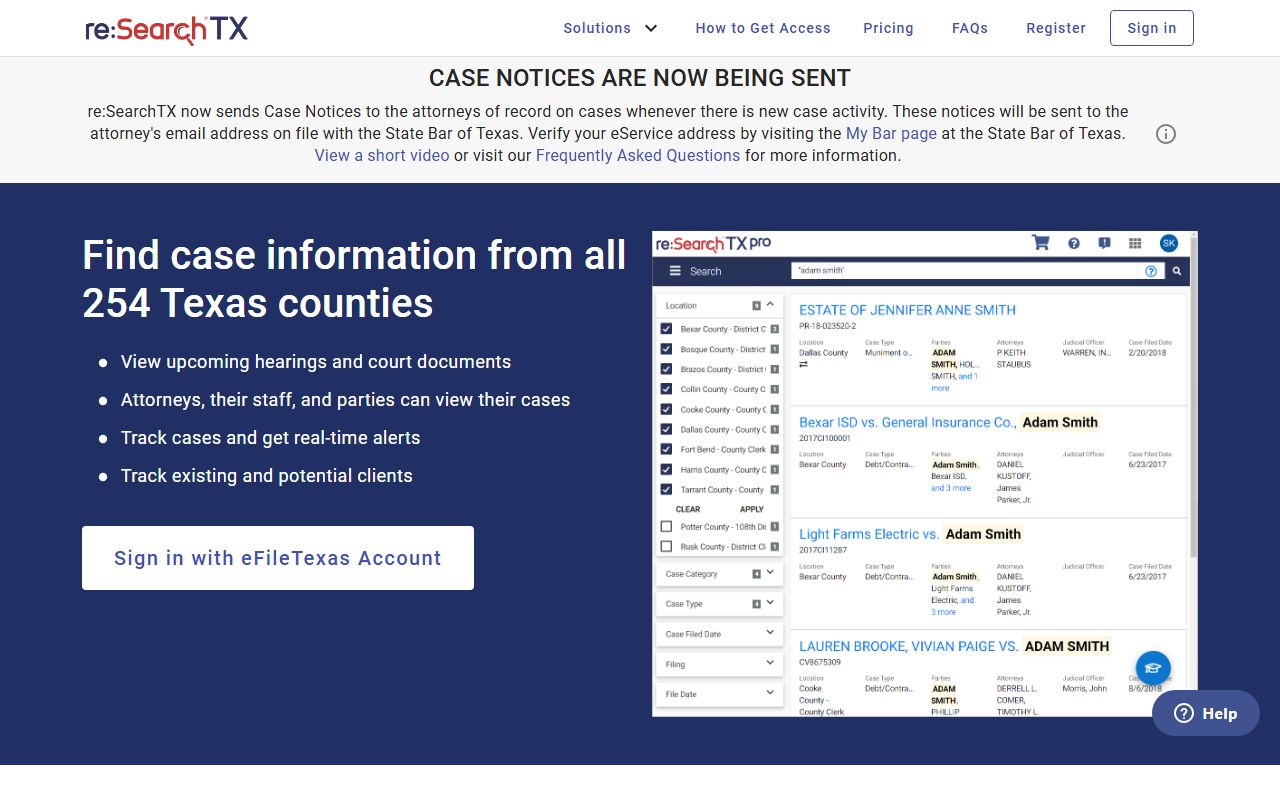
The research found no official Lipscomb-specific public criminal case-search portal on the county site. The District Clerk page provides contact information, court-support materials, nondisclosure forms, appointed-attorney reports, and the 2026 case schedule, but it does not publish a searchable criminal case index. The statewide re:SearchTX portal exists, though availability depends on court participation, role, registration, and access level.
Find Lipscomb County Court Records After Arrest
The most reliable local path is to identify the arrest, then ask the correct court office whether a case has been filed. Sheriff Ben Eggleston's office may confirm custody or immediate bond status through the Lipscomb sheriff page phone route. The District/County Clerk is the main contact for district and county criminal case records. Justice of the Peace matters use the JP office. If a person was just booked, the case may not yet have a number.
- Confirm the arrest and custody status with the sheriff/jail at 806-862-2611.
- Ask whether a court case number, court name, or next hearing is available.
- Contact the District/County Clerk for filed district or county criminal matters.
- Use re:SearchTX if the case is available through the statewide portal and your access level permits it.
- For JP-level matters, contact the Justice of the Peace rather than the jail.
The District/County Clerk office is listed at 101 South Main, P.O. Box 70, Lipscomb, TX 79056, phone 806-862-3091, fax 806-862-3004, and email chrissy.dunn@co.lipscomb.tx.us. Its hours are 8:30 a.m. to 5:00 p.m., closed noon to 1:00 p.m. for lunch. Use the District Clerk page, the County Clerk page, or the Justice of the Peace page based on the case level. The re:SearchTX landing page is the statewide portal to try when a case is included.
Lipscomb Court Record Search Fields
Because no county-hosted criminal case search interface was found, the search fields are the details a clerk or portal needs. A case number is best. If no case number exists yet, use the defendant's full legal name, date of birth if available, arrest date, court, and record type. Ask for the docket sheet, charging instrument, bond paperwork, judgment, or disposition if the request is for a specific document.
| Field Label | Type | Required | Options / Format Notes |
|---|---|---|---|
| Defendant name | Clerk request / portal if available | Usually required without case number | Provide full legal name and date of birth if possible. |
| Case number | Clerk request / portal if available | Best identifier | Ask sheriff or court once assigned. |
| Court | Office selection | Important | District, county, or justice court depending on charge. |
| Date range | Request detail | Optional | Use arrest, filing, or hearing date. |
| Record type | Request detail | Optional | Complaint, information, indictment, docket sheet, judgment, or bond paperwork. |
Lipscomb County Prosecutor Records
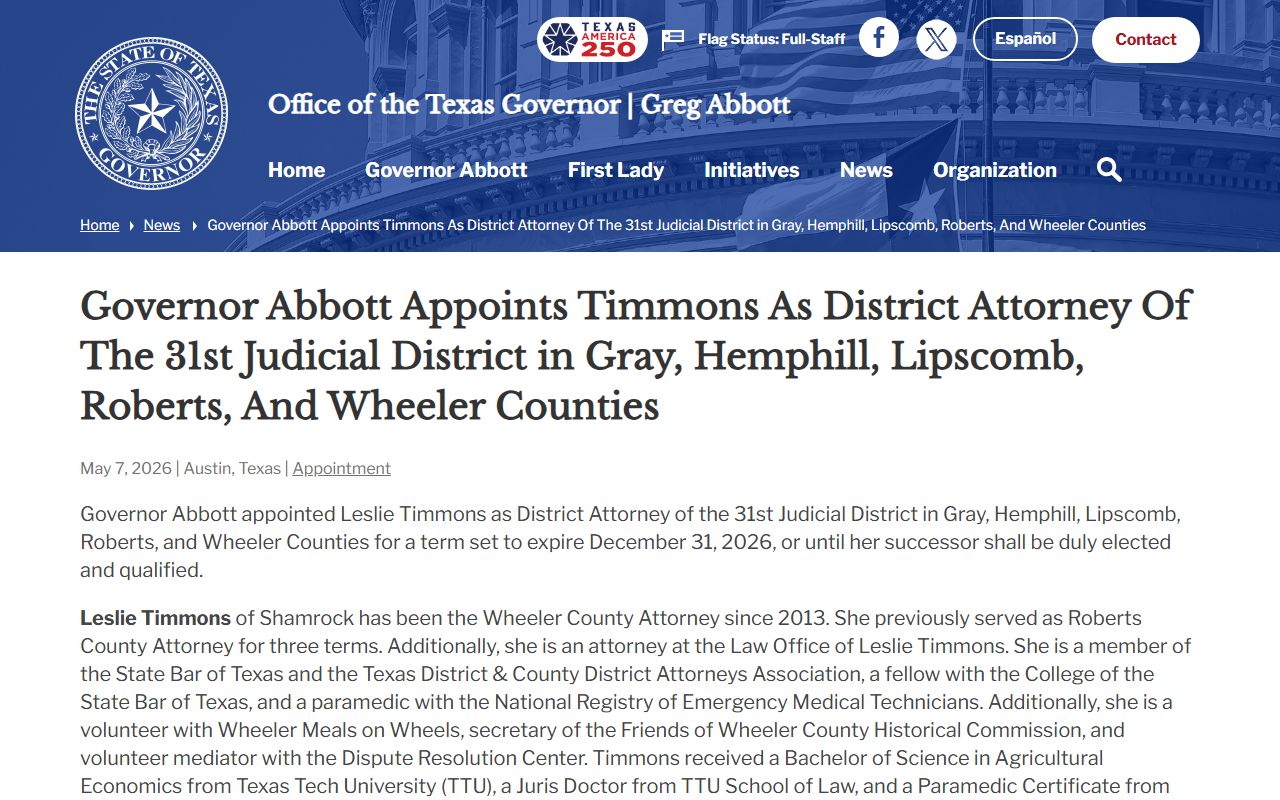
The 31st Judicial District covers Gray, Hemphill, Lipscomb, Roberts, and Wheeler Counties. The county District Attorney page still listed Franklin McDonough in the research, but the Governor of Texas issued a May 7, 2026 appointment notice naming Leslie Timmons as District Attorney of the 31st Judicial District for a term expiring December 31, 2026 or until a successor is elected and qualified. The Texas Register notice says the same. Use Leslie Timmons as current as of the June 30, 2026 research date, with the county page lag noted.
The County Attorney page lists Matthew D. Bartosiewicz, phone 806-658-4545, fax 806-658-4524, and email matt@lemon-lawfirm.com. Local prosecution duties can depend on case type. A booking charge at the jail is the arrest-side label. The prosecutor may file a different charge, amend a charge, reject a charge, or present a felony matter to a grand jury.
The Governor's appointment notice is the dated official source for the 31st Judicial District Attorney change.
Charges After a Lipscomb Arrest
Charges in court records after a jail arrest can appear through several charging documents. A complaint is a sworn allegation often used to begin a case. An information is filed by a prosecutor and is common in non-indictment cases. An indictment is returned by a grand jury, often for felony prosecution. These are not the same as a booking charge on the jail side.
| Document | Who Uses It | What It Means |
|---|---|---|
| Complaint | Officer or prosecutor route | Sworn charging document that can start a criminal case. |
| Information | Prosecutor | Formal prosecutor-filed charge used in many non-indictment cases. |
| Indictment | Grand jury | Grand-jury charging document often used for felonies. |
Lipscomb Charge Status Meanings
A court charge can change after an arrest. It can remain pending, be amended, reduced, dismissed, or resolved by plea or trial. A dismissal is not the same thing as expunction. A conviction is not the same thing as an arrest. Court records after a jail arrest should be read by date, court, document type, and status.
| Status | What It Means |
|---|---|
| Pending | The charge is filed and unresolved. |
| Amended / Reduced | The filed charge changed from the original wording or level. |
| Dismissed | The court record shows the charge was ended without conviction on that charge. |
| Disposed | The case has a final action, such as plea, trial result, dismissal, or other judgment. |
Bond Records After Arrest
No Lipscomb County online bond payment page or jail-specific bond fee schedule was found. After an arrest, bond may be addressed by a magistrate, justice court, county court, or district court depending on the charge and stage. Call the sheriff/jail first to ask whether bond has been set, where it must be posted, what payment methods are accepted, and whether another hold blocks release.
| Bond Type | How It Works |
|---|---|
| Cash bond | The full amount is deposited with the proper authority, with refunds and costs depending on court outcome. |
| Surety bond | A licensed bail bond company posts bond for a fee and guarantees appearance. |
| Personal / PR bond | Release based on promise and conditions rather than full cash deposit, by judicial decision. |
| No-bond hold | Release is not available on that charge or hold until a judge or holding agency changes status. |
Warrants Before a Jail Arrest
No official Lipscomb County active warrant list, sheriff warrant search page, most-wanted page, or app-based warrant tool was located. A warrant still may exist. Check through the sheriff, the court that issued the warrant, the District/County Clerk, or the Justice of the Peace. JP matters use phone 806-862-3844 and the JP public-information route by mail or email.
Once a warrant leads to arrest, the jail books the person and the warrant or charge may appear in jail records or later court filings. Bond may release the person only if no other holds exist. Clearing a warrant can require court appearance, bond, payment plan, attorney action, or surrender, depending on warrant type.
Charges vs Convictions
An arrest charge and a court charge are accusations. A conviction is a final outcome after plea, verdict, or other judgment. DPS statewide criminal history is useful for public conviction and deferred-adjudication information, but it is not a live jail roster or a substitute for clerk records right after arrest.
| Charge | Conviction | |
|---|---|---|
| Stage | Accusation after arrest or filing | Final court outcome by plea or verdict |
| Meaning | Alleged offense, not proof of guilt | Legal finding or accepted plea |
| Where found | Jail, prosecutor, or court filings | Court judgment and criminal-history systems |
Sealed and Expunged Records
Texas Code of Criminal Procedure Chapter 55 governs expunction, the process for eligible people to remove certain arrest records from public access. Nondisclosure is a separate sealing route that limits public access but does not always erase the record for every government purpose. Eligibility depends on the case outcome, charge, timing, and court order.
| Nondisclosure / Sealed | Expunction | |
|---|---|---|
| Public visibility | Limited from public access by court order | Destroyed or removed from public access where ordered |
| Government access | May remain available to some agencies | Much more limited after order compliance |
| Best source | Court order and clerk | Texas Code of Criminal Procedure Chapter 55 |
DPS and Background Records
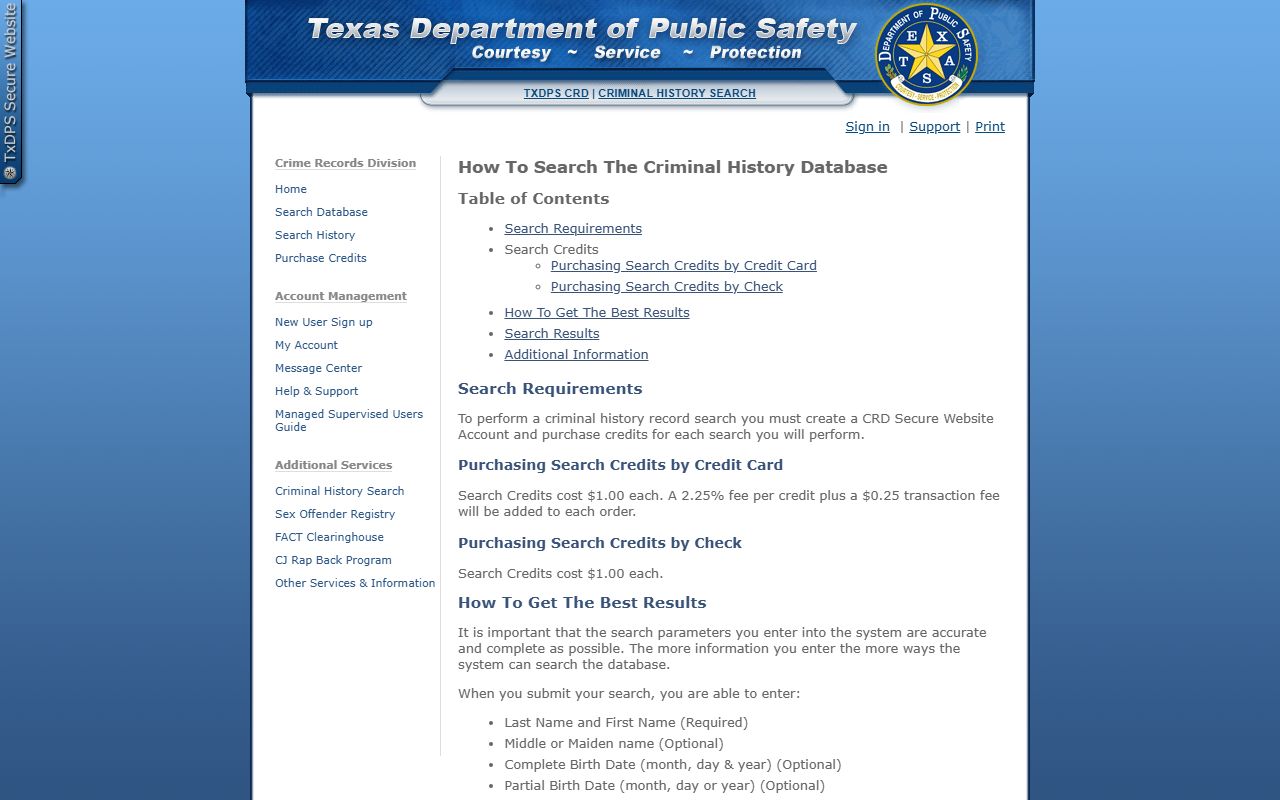
The Texas DPS Criminal History Name Search requires a CRD Secure Website account and search credits. The DPS help page explains the account and credit process. DPS also has a CR-42 mail form for public criminal-history data, with a $10 search fee by check or money order in the research. These are statewide criminal-history routes, not local booking confirmation.
The DPS criminal-history help page explains the account-based search-credit requirements.
Important: Do not use casual court-record lookups for employment, housing, credit, insurance, or other FCRA-covered screening.
Restricted Lipscomb Court Records
Texas public access is broad, but not every record is public. Juvenile records, sealed or expunged records, confidential victim or witness information, active law-enforcement material, and records made confidential by another law may be withheld or redacted. Texas Government Code Section 552.108 can protect certain law-enforcement or prosecution information, while subsection (c) preserves access to basic information about an arrested person, an arrest, or a crime.